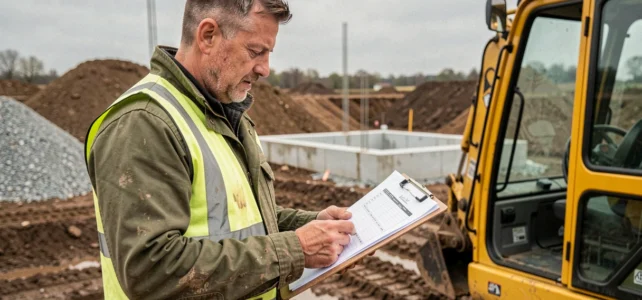
On a trench or civil engineering site, the mini excavator rarely operates eight hours a day all year round. This reality of intermittent use completely changes the way to build a budget: the monthly cost should be measured not in gross rent, but in the actual margin generated per day of operation. Preparing a budget for a mini excavator starts with comparing the price of the machine to the number of days it generates revenue.
Actual monthly charge: include costs that rent does not show
The amount displayed on a leasing or rental agreement represents only a fraction of the actual charge. We often forget machine breakage insurance, preventive maintenance (filters, hoses, lubrication), transportation between sites, and fuel.
To estimate the complete monthly charge, we add the rent, insurance, a maintenance provision, and the average transportation cost. This total must be covered by the margin attributable to the machine, not by the gross revenue of the day.
When preparing a file for financing and leasing of mini excavators, this complete charge is the first figure to put on the table. An attractive rent loses all its interest if ancillary costs double the monthly bill.
The coverage threshold is calculated in net billed days, not in revenue. If the margin per day after operator and fuel is known, we divide the total monthly charge by this margin. The result gives the minimum number of working days for the machine to cost nothing to the company.

Leasing, rental or LLD: what changes in the exit budget
Leasing is often discussed as a single block, but there are structural differences that weigh heavily at the end of the contract.
- Leasing (or rental with an option to purchase) allows you to become the owner at the end of the contract for a residual value set from the start. The budget must include this final amount, which can represent a significant portion of the initial price.
- Long-term rental (LLD) does not provide for a buyout: the machine is returned. The advantage is often a lower rent and no surprises at the end, but you do not capitalize anything.
- Classic credit makes you the owner from day one. The trade-off: a higher initial contribution and a direct impact on cash flow and the balance sheet.
The choice between these formulas depends on the expected duration of use and the realistic occupancy rate. For seasonal activity or as a fleet supplement, LLD limits risk. For a machine that operates all year round on regular sites, leasing offers better long-term returns.
Promotional rates on new mini excavators
Some manufacturers occasionally offer leasing campaigns at very low rates on new mini excavators. These offers can significantly alter the comparison between new and used. Before signing, check the duration of the promotional rate, the conditions for early exit, and any maintenance obligations with the dealer.
Budget for new or used mini excavators: decide based on the total cost of ownership
The natural reflex is to compare the purchase price. In practice, it is the total cost of ownership over the duration of the contract that distinguishes the two options.
A used mini excavator has a lower entry price and reduced monthly payments. In return, maintenance costs increase with accumulated hours, and the residual value at the end of the contract drops faster. A new machine costs more upfront but benefits from a manufacturer’s warranty and generally optimized fuel consumption.
To decide, we lay out both scenarios over the same duration:
- Total monthly payment (rent + insurance + predictable maintenance)
- Estimated residual value or return cost
- Number of expected annual hours and expected reliability
- Availability of parts and downtime in case of breakdown
A well-constructed budget compares two columns over the same duration, not two catalog prices.
The trap of a too high down payment
Injecting a significant down payment to reduce monthly payments seems logical. For a mini excavator that serves as a fleet supplement, this is often a mistake: this down payment ties up cash that could be used on a job site. Sometimes it is better to accept a slightly higher rent and keep liquidity to absorb an unforeseen event, a delay in client payment, or a need for accessories.
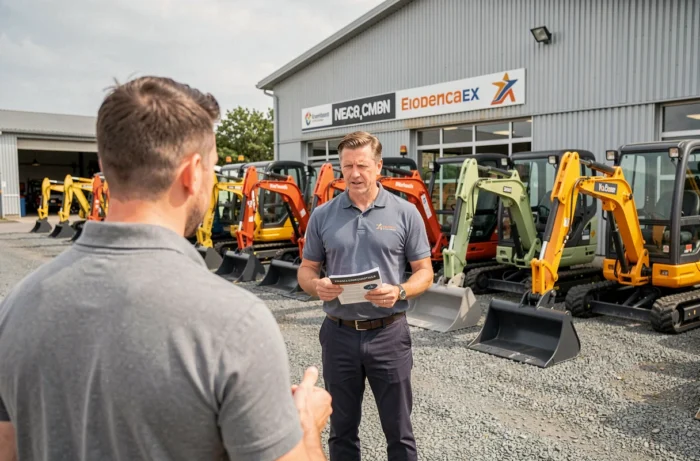
Contract duration and usage rate: the couple not to overlook
The duration of the financing contract must align with the actual lifecycle of the machine in the company. A contract that is too long exposes you to increasing maintenance costs on an aging machine whose residual value collapses. A contract that is too short inflates the monthly payments and can put pressure on cash flow.
In practice, the duration is aligned with the expected volume of hours. A mini excavator used intensively reaches its renewal threshold faster than a backup machine that operates a few days a month. Returns vary on this point depending on brands and usage conditions, but the principle remains the same: the duration of the contract follows the actual wear rate, not a banking standard.
Before signing, ask the financier for a simulation with two different durations to visualize the total cost difference. This comparison takes a few minutes and avoids committing to a duration that is unsuitable for your activity.
The market for construction equipment financing is evolving towards more rental solutions, driven by pressure on cash flow and uncertainty in order books. Preparing your budget today means integrating this flexibility into the reasoning, even if it means mixing leasing for the main machine and LLD for a supplementary machine.