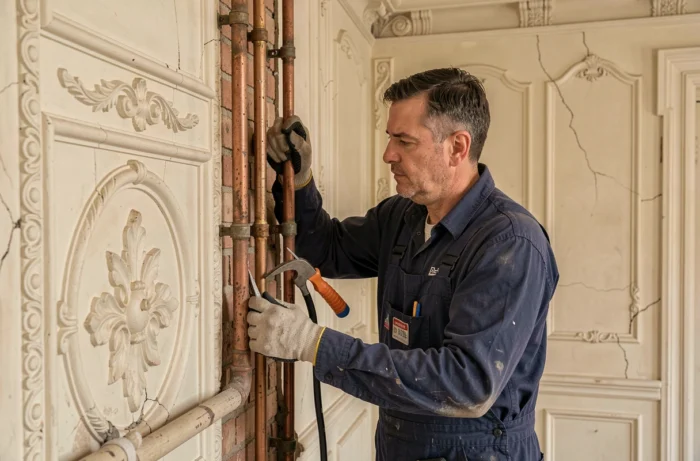
When dealing with the plumbing of a listed mansion in Brussels, the first instinct is not to choose a material or a plumber. It’s to check whether simply drilling into a technical wall requires a permit. In a listed property in the Brussels Region, the line between routine maintenance and restoration requiring authorization is blurred, and it’s precisely this ambiguity that complicates every step of the project.
Permits and Heritage: A Constraint That No One Anticipates Early Enough
For a property listed on the safeguarding list or classified, the Directorate of Cultural Heritage of the Brussels Regional Public Service considers that even a like-for-like replacement may require a permit. A cast iron pipe replaced by a cast iron pipe, in the same location, with the same diameter, can trigger a procedure if the intervention affects a protected element or modifies an existing opening.
Specifically, as soon as one considers relocating a riser, crossing a classified interior facade, or doubling a technical wall, the administration recommends consulting them before starting any work. This is not a light administrative formality: the heritage opinion can take several weeks, and a refusal necessitates a complete redesign of the piping layout.
Before contacting a contractor, the safest approach is to renovating the plumbing of a listed property in Brussels requires understanding these regulatory constraints to avoid a project stalled halfway through.
Piping Layout in a Listed Building: Adapting the Route to the Structure
In a recent construction, you can drill where you want (or almost). In a 19th-century Brussels mansion, every load-bearing wall, every interior cornice, every ceiling molding limits the options. The plumbing layout must adapt to the building, not the other way around.
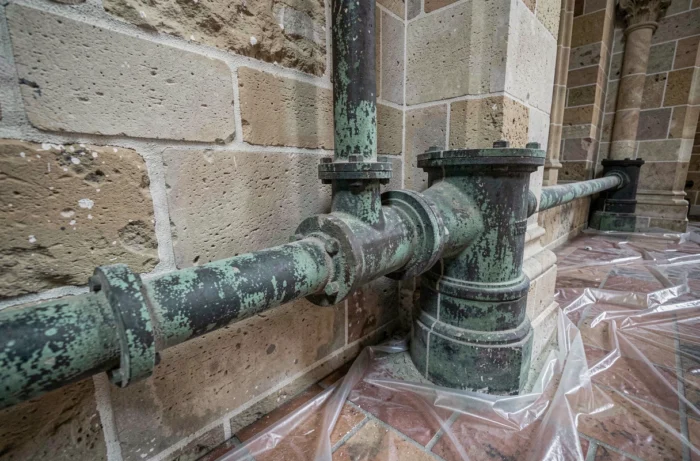
It is common to find lead or cast iron pipes that follow illogical paths according to current standards, but which exploit original technical voids. Removing these historical routes to draw straight lines in PEX (cross-linked polyethylene) may seem rational on paper, but it can involve drilling into protected partitions.
Materials Compatible with Heritage Projects
The choice of materials is not limited to hydraulic performance. One must also consider the reversibility of the intervention, a criterion valued by the heritage administration. PVC pipes are suitable for drainage, PEX for hot and cold water supply, but each crossing of a classified wall must remain removable without damaging the support.
- Crimp or compression fittings on PEX avoid welding and limit thermal damage to adjacent moldings or woodwork.
- Through sleeves with a sheath allow passing through a wall without fixing the pipe directly into the historical masonry.
- Anti-vibration clamps reduce mechanical stress on sometimes fragile supports (old bricks, original plaster).
Feedback varies on the durability of PEX in configurations where pipes remain difficult to access behind listed paneling. In these cases, some craftsmen prefer copper for its proven longevity, despite a higher cost.
Subsidies for Work on Listed Properties in Brussels: A Financial Lever Distinct from Renovation Grants
The Brussels Region offers a specific subsidy for conservation work on listed properties, which covers maintenance, restoration, and even preliminary studies. This scheme is distinct from the classic energy renovation grants that any Brussels owner can apply for.
The difference is significant: classic renovation grants target insulation, heating, and energy performance. The heritage subsidy, on the other hand, can finance technical interventions related to the preservation of the structure, including the replacement of pipes if it is part of a conservation project.
Combining Both Schemes
An owner renovating the plumbing of a listed apartment can, in some cases, combine the heritage subsidy with renovation grants, provided that the work simultaneously meets conservation and energy improvement objectives. For example, replacing an outdated hot water circuit with a high-performance system can fall under both frameworks.
The key is to prepare the file in advance, before the start of the project. Heritage subsidies generally require prior validation of the project by the administration, which aligns with the obligation to consult the Directorate of Cultural Heritage mentioned earlier.
Coordinating Plumber and Heritage Architect: A Field Necessity
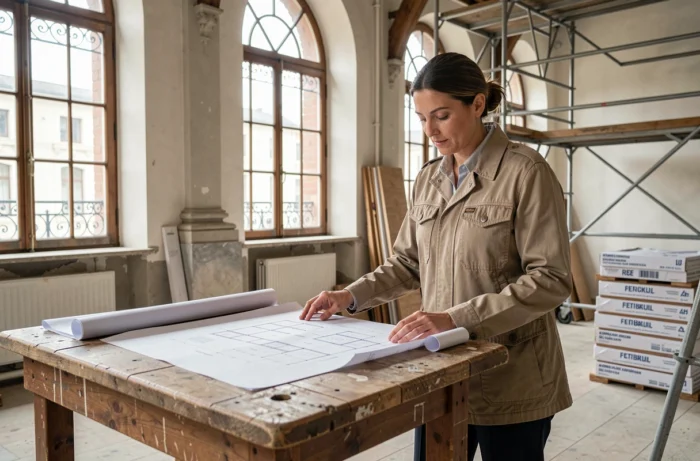
On a typical bathroom or kitchen renovation project, the plumber works alone or with a general contractor. In a listed property, the heritage architect becomes a mandatory contact as soon as the work exceeds routine maintenance.
This coordination comes at a cost and extends the timeline. You don’t initiate a plumbing quote in isolation: you first need a survey of the existing conditions that identifies protected elements, then a layout validated by the architect, and finally an estimate of the work that incorporates the constraints of reversibility and access.
- The heritage survey identifies moldings, cornices, woodwork, and masonry to be preserved.
- The layout plan must propose alternatives in case of refusal to drill into a classified element.
- The budget must include a margin for discoveries during the project (hidden lead pipes, asbestos in joints).
A plumber accustomed to new builds or standard renovations may not necessarily master these constraints. Seeking a craftsman experienced in old structures in Brussels, ideally recommended by a heritage architect, avoids costly mistakes.
Old Drainage and Connection to the Network: The Pitfall of Lead Pipes
Many listed properties in Brussels retain lead pipes, particularly for drainage and sometimes for water supply. Lead poses a known health issue, but in a listed property, it is not always possible to tear out the entire network without compromising the structure.
The most common solution is to line the existing pipes or create a new parallel network using available technical voids, without touching the historical conduits that remain in place but are neutralized. Neutralizing rather than demolishing protects the structure and simplifies permissions.
Connecting to the public water network remains subject to the usual municipal rules, but passing through the facade may require additional heritage approval if the facade is classified. Yet another step to anticipate in the planning.
Renovating plumbing in a listed property in Brussels costs more and takes longer than a standard project. Owners who consult the heritage administration early in the planning phase, even before requesting a quote, gain several months on the overall timeline and limit the risk of having to redo work.