The letter K encompasses a small number of botanical genera, often unknown in France, but possessing very distinct cultural characteristics. Some tolerate poor and dry soils, while others require acidic soil or partial shade. Identifying these differences before planting avoids most failures in the garden.
This article details ten species whose names begin with K, specifying for each the type of soil, exposure, and hardiness. The goal is to provide concrete guidelines for choosing based on your terrain, not just to list names.
Kniphofia and Pollinators: A Useful Perennial for the Dry Garden
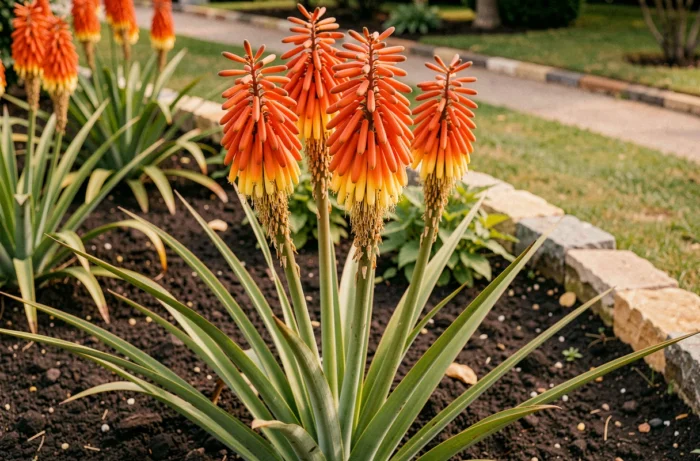
The Kniphofia, sometimes called red hot poker, produces tubular floral spikes in shades of orange, red, or yellow. The flowering generally extends from summer to autumn, making it a late nectar source for pollinating insects.
The Royal Horticultural Society classifies Kniphofia among the plants recommended for pollinators. This ecological criterion goes beyond mere decorative appeal: a bed of Kniphofia attracts bumblebees and solitary bees during a time when floral resources are dwindling.
In terms of cultivation, this perennial requires a well-drained soil and full sun. It fears stagnant moisture in winter, which can rot the crown. On clay soil, adding gravel at planting solves the problem. Compact varieties are suitable for narrow borders and gravel gardens, a use that large catalogs increasingly highlight for small spaces.
Among the flowers starting with the letter k, Kniphofia is probably the one that best combines low maintenance, visual impact, and ecological usefulness.
Kalanchoe Indoors and Kalmia in Woodlands: Two Opposite Requirements
The Kalanchoe is a tropical succulent grown as a houseplant or balcony plant in our latitudes. Its flowering lasts several weeks, sometimes several months, with minimal watering. It is enough to let the substrate dry between waterings to avoid root rot.
This frugality in water makes it a logical choice for south-facing windowsills or bright verandas. The color palette (pink, red, orange, yellow, white) allows for varied compositions without multiplying maintenance constraints.
Kalmia latifolia: Toxic Beauty in Acidic Soil
The Kalmia, or mountain laurel, naturally grows in the acidic underbrush of North America. Its cup-shaped flowers, white to pink, appear in May-June. The plant requires acidic heath soil and a partially shaded exposure, exactly the opposite of Kniphofia.
A point not to be overlooked: all parts of Kalmia are highly toxic. Planting it in a garden frequented by young children or pets requires careful consideration. This toxicity clearly distinguishes it from other shade shrubs like rhododendron, with which it shares the same growing conditions.
Kerria japonica and Kolkwitzia: Spring-Flowering Shrubs
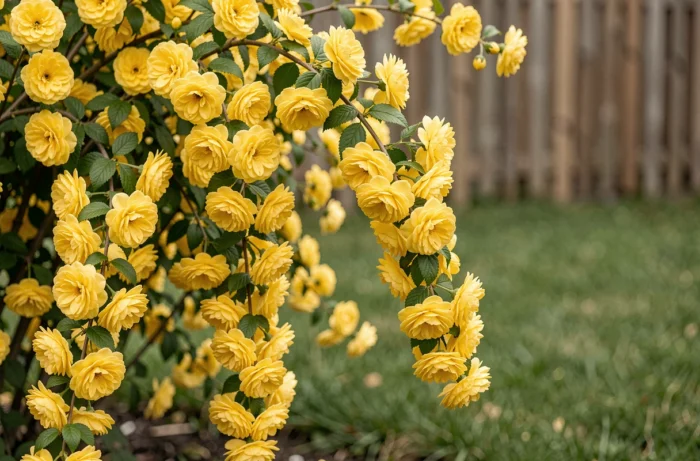
The Kerria japonica, or Japanese kerria, produces bright yellow flowers, either single or double, from early spring. The shrub tolerates partial shade and adapts to most ordinary soils. Its flexible silhouette and green stems remain decorative even in winter, after the leaves have fallen.
Maintenance is limited to pruning after flowering to renew the branches. The double-flowered variety (‘Pleniflora’) is the most common in garden centers, but the single form retains a more natural charm, better suited to free hedges or woodland edges.
Kolkwitzia amabilis: An Overlooked Shrub
The Kolkwitzia, nicknamed beauty bush, offers abundant pink flowering in late spring. Hardy and not demanding regarding soil type, it deserves a place in medium-sized gardens where its arching silhouette creates volume without regular pruning.
Its relative obscurity in garden centers is due to a commercial flaw: the flowering lasts only two to three weeks. For the rest of the year, the shrub remains green and discreet. To compensate, it is often paired with summer or autumn-flowering perennials.
Knautia, Kentranthus, and Other Perennials Starting with K for Beds and Rockeries
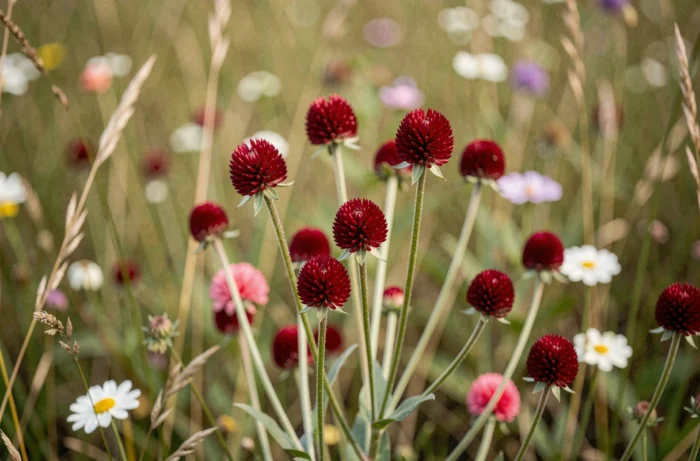
The Knautia arvensis (field scabious) is a wild perennial with mauve flowers that attracts butterflies. It self-seeds easily, sometimes too much, in light and well-drained soils. Its natural appearance suits flower meadows and cottage-style beds.
The Kentranthus (red valerian), botanically named Centranthus ruber, colonizes old walls, limestone rockeries, and dry ground. Its red or white flowering extends from May to October, making it one of the longest-flowering perennials among the K species.
Here are the last four species that complete this selection:
- Kimilsungia: a hybrid orchid of North Korean origin, very rarely cultivated in Europe, more of a botanical curiosity than a garden plant
- Kimjongilia: a hybrid begonia from the same context, nearly impossible to find in Western horticultural commerce
- Wood Knautia (Knautia dipsacifolia): the woodland version of field Knautia, which prefers partial shade and cool soils
- Kafir lily (Schizostylis coccinea): a South African perennial with autumn flowering, in red or pink stars, that enjoys cool, humus-rich soils
The Kafir lily stands out for its late flowering, often in October, at a time when few perennials are still in bloom. It fills a seasonal gap in beds, provided it is given soil that does not dry out in summer.
Choosing Your K Flowers According to Soil and Exposure
| Species | Soil | Exposure | Flowering |
|---|---|---|---|
| Kniphofia | Drained, poor | Full sun | Summer – autumn |
| Kalanchoe | Light substrate (indoor) | Bright light | Variable, long |
| Kalmia | Acidic, humus-rich | Partial shade | May – June |
| Kerria | Ordinary | Sun to partial shade | Spring |
| Kolkwitzia | Ordinary | Sun | Late spring |
| Knautia | Light, draining | Sun | Summer |
| Kentranthus | Poor, limestone | Full sun | May – October |
| Kafir lily | Cool, humus-rich | Sun to partial shade | Autumn |
The common thread among these ten species ultimately lies in their diverse requirements. A garden that combines acidic soil in woodlands, a drained bed in the sun, and a bright windowsill can accommodate most of them. The choice is made first by soil and exposure, then by the desired flowering season, and only lastly by color.