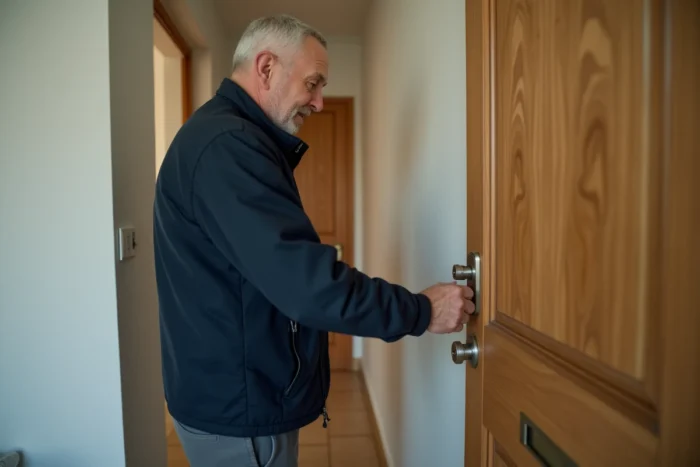
A push-button lock is operated with a simple turn of the thumb from the inside, without a key. A key lock requires a key on both sides, or at least on the outside. These two mechanisms do not protect against the same risks and are not installed in the same places. Comparing their technical characteristics allows you to determine which one is suitable for each door in your home.
Push-button lock and key lock: comparative table of characteristics
| Criterion | Push-button lock | Key lock |
|---|---|---|
| Interior opening method | Rotary button (keyless) | Key or button depending on the model |
| Exterior opening method | Key or no access | Key required |
| Burglary protection level | Low to medium (simple latch) | Medium to high (pin cylinder) |
| Picking resistance | Low (no cylinder on the inside) | Depends on the cylinder and the number of pins |
| Main usage | Interior doors, bathrooms, basements | Entrance doors, gates, technical rooms |
| Risk of locking in | Low (exit without a key) | High if the key is lost or stuck |
| Average price | Accessible entry-level | Higher depending on the quality of the cylinder |
This table highlights a clear gap on two axes: picking resistance and the risk of locking in. The choice therefore depends on the trade-off between these two parameters, which varies according to the door in question. To consult reviews on types of key locks, several technical criteria deserve detailed examination.
Cylinder and pins: what determines the resistance of a key lock
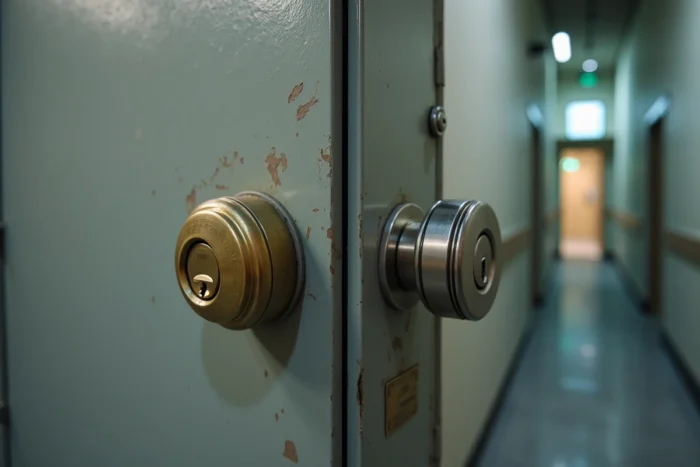
The security of a key lock relies almost entirely on its cylinder. A standard pin cylinder operates by aligning small metal springs that only the correct key can position properly. The higher the number of pins, the longer and more complex the picking becomes.
Entry-level cylinders generally have few pins and wide machining tolerances. An experienced locksmith can open them in a matter of seconds. Higher-quality cylinders incorporate counter-pins, mushroom pins, or anti-drilling systems that significantly complicate any unauthorized opening attempts.
Cylinder and certification: concrete benchmarks
The A2P (Assurance Prévention Protection) certification remains the most reliable benchmark for assessing the resistance of a cylinder. It classifies cylinders according to their resistance to destructive and non-destructive opening techniques. A certified A2P cylinder resists picking significantly better than a non-certified model, even when the latter has a similar number of pins.
The push-button lock, on the other hand, does not have a cylinder on the inside. Its protection depends solely on the latch and the strength of the casing. On the outside, a high-end push-button lock may incorporate a high-performance cylinder, but the interior side remains vulnerable to anyone already inside the home.
Usage safety and anti-locking: the criterion that guides overlook
Resistance to burglary is only one side of the problem. The other side, often underestimated, concerns usage safety: the ability to exit quickly in case of emergency, and the risk of accidental locking in.
A key lock on an interior door creates a real risk. If a child turns the key and loses it, or if an elderly person cannot find their key in a moment of panic, the locking in can last until a locksmith intervenes. Recent recommendations regarding children’s bedroom doors are clear:
- No key lock on a child’s bedroom, due to the risks of loss, key ingestion, or intentional locking in
- Prefer a non-locking latch mechanism until six or seven years old
- After this age, a lock with internal button locking and emergency unlocking from the hallway (slot or hole) is the safest compromise
This anti-locking criterion also applies to bathrooms and toilets. The push-button lock with an emergency external unlocking system allows a relative to open the door from the hallway in case of distress.
Entrance door: why the key lock remains the logical complement
On an entrance door, the reasoning reverses. The priority is no longer ease of exit (a simple turn of the button is sufficient from the inside), but resistance to opening from the outside. A key lock added in addition to a multi-point lock creates an additional locking point that the intruder must neutralize.
Locksmith experts recommend maintaining at least one purely mechanical locking point with a key on the entrance door, even when a connected lock is installed. This precaution ensures access in case of battery failure or electronic system malfunction.
Push-button lock as an interior complement
Some installers offer a push-button lock on the inside of the entrance door, in addition to the main lock. This device allows for quickly securing the door at night without searching for the key. It does not replace the key lock, but adds a layer of quick locking usable only from the inside.
This combined configuration (multi-point lock, key lock, interior push-button lock) covers both burglary protection and daily usage comfort.
Selection criteria according to door type
- Entrance door: key lock with quality cylinder, possibly complemented by an interior button
- Child’s bedroom door: button locking with emergency unlocking from the outside, never a key lock
- Bathroom or toilet: push-button lock with external unlocking device
- Basement or technical room door: key lock, as picking resistance is paramount and no one risks being locked in for long
The choice is not limited to the question “button or key.” It depends on the door, its occupants, and the main risk to cover. On an entrance door, the cylinder and its pins determine the level of protection. On an interior door, it is the anti-locking mechanism that decides.