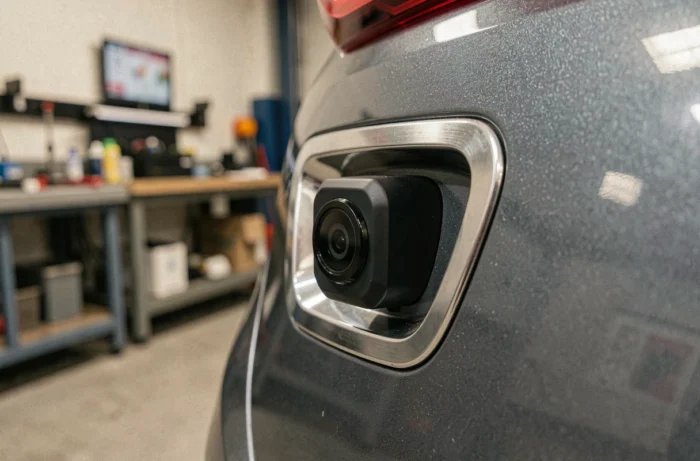
The 2026 Volkswagen T-Roc marks a turning point in the standard parking assistance equipment offered. While the previous generation reserved the rearview camera for optional packages or high trims, the technical specifications of the mid-range versions now display this feature as standard in several European markets. What concrete differences separate the old model from the new in this specific area, and what do the technologies already deployed on other Volkswagens suggest for the future?
T-Roc Rearview Camera: Standard Equipment vs. Option, What’s Changing in 2026
The first T-Roc, launched in 2017, offered the rearview camera as an optional element, often included in a package that grouped parking sensors and parking assistance. For the 2026 generation, announcements of new vehicles in Poland, Romania, and South Africa confirm that the rearview camera is integrated into standard equipment on mid-range versions, paired with Park Assist or Park Assist Plus.
This shift from optional status to standard equipment reflects a direct response to the European regulation GSR2 (EU 2019/2144), which gradually mandates rear detection systems on new vehicles. For the evolution of T-Roc rearview cameras, this transition to standard also modifies the pricing structure: the additional cost associated with parking assistance packages disappears on mid-range trims.
| Criteria | T-Roc 1 (2017-2024) | T-Roc 2 (2026) |
|---|---|---|
| Rearview Camera | Option or package | Standard (mid-range) |
| Park Assist | Option on high trims | Standard or Park Assist Plus depending on version |
| Rear Sensors | Standard on certain trims | Standard on all versions |
| 360° Panoramic View | Not available | Area View optional on high trims |
| Park Assist Pro (memory + smartphone) | Not available | Not confirmed, but deployed on ID. Polo |
Park Assist Plus and Pro: Features that Differentiate T-Roc Trims in 2026
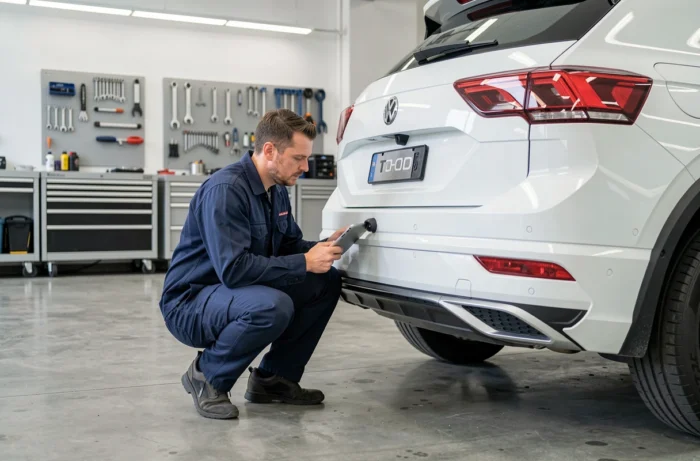
The upgrade is not limited to the presence of a camera. The Park Assist Plus combines front and rear sensors with semi-automatic steering guidance during parking maneuvers and parallel parking. This version is documented in the equipment sheets of the 2026 T-Rocs marketed in Europe.
On the other hand, Park Assist Pro, already operational on the ID. Polo 2026, adds two functions absent from the standard Park Assist Plus:
- A memory function capable of recording a parking route and reproducing it automatically, for example in a personal garage or a recurring parking spot.
- Remote control via smartphone, allowing the maneuver to be initiated and supervised without being seated in the vehicle.
- Integration with ultrasonic sensors and peripheral cameras to manage tighter spaces than those accepted by Park Assist Plus.
Volkswagen has not yet confirmed the availability of Park Assist Pro on the 2026 T-Roc. The deployment on the ID. Polo suggests a gradual extension to other models on the MQB Evo platform, of which the T-Roc is a part.
GSR2 Regulation and Rearview Cameras: Constraints Shaping the T-Roc
The European regulation EU 2019/2144 (General Safety Regulation 2) requires manufacturers to equip new vehicles with systems for detecting vulnerable road users at the rear. This obligation, which has been phased in gradually, explains why the rearview camera becomes standard on the 2026 T-Roc while it remained optional on the previous generation.
The UNECE standards R158 and R159 more specifically regulate rear detection devices and blind spot information systems. The 2026 T-Roc incorporates these requirements from the base version, which reduces the equipment gap between entry-level trims and high-end ones.
This regulatory constraint has a collateral effect on the used car market. First-generation T-Rocs lacking a rearview camera find themselves out of sync with the expectations of buyers accustomed to this feature being standard on competing new models.
Ultrasonic Sensors and Camera: Two Complementary Logics
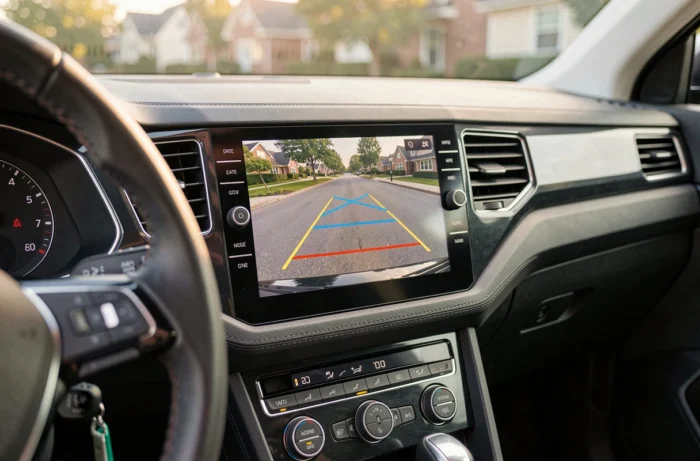
The rearview camera provides a video image with dynamic trajectory lines. Ultrasonic sensors, on the other hand, detect nearby obstacles without depending on lighting conditions. On the 2026 T-Roc, both systems operate simultaneously to cover both the visible area on the screen and the nearby blind spots close to the bumper.
This combination reduces uncovered areas during reverse maneuvers, a documented weak point on vehicles equipped only with sensors without video feedback.
Area View 360° and Perspectives by 2026: What the T-Roc Could Borrow from the Tiguan
The Area View system, which combines feeds from multiple cameras to generate a bird’s-eye view of the vehicle, is offered as an option on high trims of the 2026 T-Roc. On the latest generation Tiguan, this function is already more widely available and associated with rear cross-traffic alerts.
The question for the coming months revolves around the descent of these functions to the mid-range trims of the T-Roc. The cost of camera modules has significantly decreased in recent years, making the democratization of Area View on less expensive versions plausible.
The deployment of Park Assist Pro with memory and smartphone control, already validated on the ID. Polo, represents another probable evolution. If Volkswagen follows its usual pattern of technological diffusion within its range, the T-Roc could benefit from this feature during a software update or an interim model year before the end of 2026.
The 2026 T-Roc transitions from a model where the rearview camera was a selling point of high trims to a vehicle where it is part of the minimal technical foundation. The next step, already visible on other Volkswagen models, is to transform assisted parking into a nearly autonomous function, controllable from a phone.