
Organizing your time is not just about making a to-do list every morning. Time management relies on a precise mechanism: identifying high-value activities, allocating protected time slots for them, and reducing interruptions that fragment concentration. When this mechanism goes off track, the day fills up without making progress on priorities.
Attention Fragmentation: The Real Barrier to Daily Productivity
Articles on time management often discuss methods but rarely address the problem they aim to solve. This problem has a name: attention fragmentation. Every notification, every message that pops up in the middle of a complex task imposes a cognitive cost when returning to the main activity.
Analyses published in 2026 by ActivTrak show that deep concentration time at work has reached its lowest level in three years. Increased meetings and constant digital alerts reduce the periods when the brain can process a subject in depth.
The problem does not only affect office workers. In remote work, according to a study reported by Phys.org and published in Organization Science in 2026, remote days reduce energy fluctuations due to fewer direct interruptions, but the mental load associated with digital tools persists. Protecting deep work slots becomes a skill in itself, regardless of location, and resources like letempsquilfaut.com help structure this reflection on personal time management.
Blocking Time Slots in Your Calendar Instead of Listing Tasks
Most organizational advice starts with “make a to-do list.” The problem is that a task list contains no information about the time needed for each activity. The result: the list grows longer, priorities get mixed up, and the feeling of overwhelm increases.
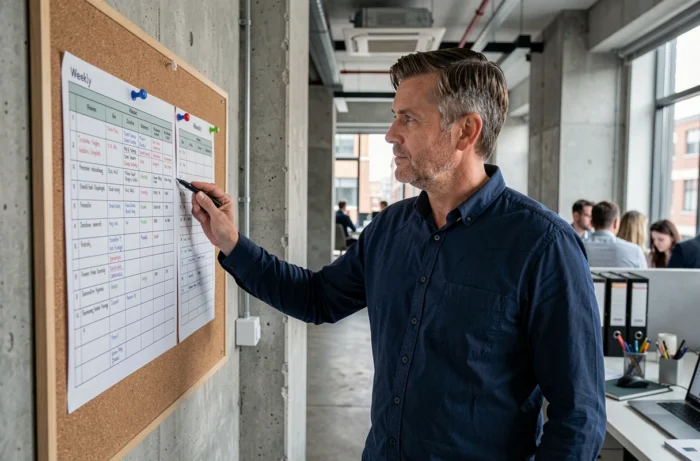
Blocking time slots in the calendar (or time blocking) reverses the logic. Instead of filling a list, you reserve dedicated time slots for each type of work: background tasks, meetings, message processing, breaks.
This approach works because it makes the actual available time visible. A workday rarely contains more than four to five hours of productive work once meetings, email management, and unforeseen events are subtracted. Seeing these constraints on a calendar forces you to make choices: postpone a secondary task, shorten a meeting, group similar activities into one slot.
Grouping Similar Tasks to Reduce Transition Costs
Switching from a spreadsheet to writing an email, then to a video conference, and back to the spreadsheet: each transition between different types of activities consumes cognitive energy. Grouping similar tasks into the same time block reduces these transitions.
In practice, this can take the following form:
- A 30-minute slot in the morning to handle all pending emails and messages, rather than checking them continuously
- A two-hour uninterrupted block for reflection or creative tasks (writing, analysis, design)
- A slot at the end of the day for quick administrative tasks that do not require deep concentration
The gain does not come from a magic tool. It comes from the fact that the brain stays in a homogeneous mode of operation longer.
Priorities and Sorting Method: Distinguishing the Urgent from the Structuring
Not all tasks that seem urgent are. And some activities that never seem urgent are the ones that transform productivity in the long run. Sorting your priorities requires a clear criterion, not intuition.
An effective sorting relies on two questions asked for each task:
- If this task is not done today, what concrete consequence occurs within 48 hours?
- Does this task directly contribute to a defined goal for the week or month?
- Can it be delegated or automated without significant loss of quality?
Tasks that answer “no immediate consequence” to the first question and “no” to the second are the ones that clutter the day without making progress. Identifying them allows you to free up time for structuring activities: planning, training, foundational work.

Energy Management Throughout the Day: Adapting Tasks to Your Rhythm
Organizing your schedule is not just about hours. The quality of attention varies throughout the day. Placing a complex task at the wrong time condemns it to take longer and produce a mediocre result.
Most people experience a peak of alertness in the morning (two to four hours after waking) and a dip in early afternoon. Scheduling demanding tasks during the peak of alertness and reserving mechanical activities (emails, filing, routine calls) for the dips is often an underestimated lever.
The study published in Organization Science in 2026 confirms that remote workers experience less variation in energy throughout the day, partly due to greater control over their schedules. Controlling one’s planning is not an organizational luxury; it is a direct factor in consistency of effort.
Short Breaks and Active Recovery
Working without breaks does not produce more results. After a period of sustained concentration, attention capacity drops. Short breaks (five to ten minutes every hour, or according to a personally adapted rhythm) allow the brain to reset.
The key point: the break must be real. Scrolling through a news feed is not a cognitive break. Walking, stretching, or simply looking out the window provides a recovery effect that screen consultation does not offer.
A schedule that incorporates recovery lasts over time, whereas a saturated plan collapses at the first unforeseen event. The most effective time management is the one that leaves room, not the one that fills every minute.