
The French real estate market has been going through a unique phase since the beginning of 2026. After a brief improvement observed in 2025, the momentum is slowing down in several regions, while certain segments are managing to stand out. Unconventional properties, long considered marginal, are capturing an increasing share of attention from buyers and investors.
Real Estate Market 2026: A Normalization That Masks Regional Disparities
In Île-de-France, data from the Notaires du Grand Paris shows that sales of existing homes fell by 3% between February and April 2026 compared to the same period in 2025. Prices remain generally stable, but the recovery that began last year is not being confirmed. The market is described as undergoing a slow normalization phase, with volumes higher than those of 2023-2024 without regaining true dynamism.
This situation in Île-de-France does not reflect the entire territory. Some medium-sized towns and well-connected rural areas are still experiencing strong activity, driven by remote work and the search for a better living environment. In contrast, the most expensive metropolitan areas are seeing their sales timelines extend. Buyers looking for diverse listings can explore the real estate portal of Atypique Info, which notably lists properties that deviate from the usual standards.
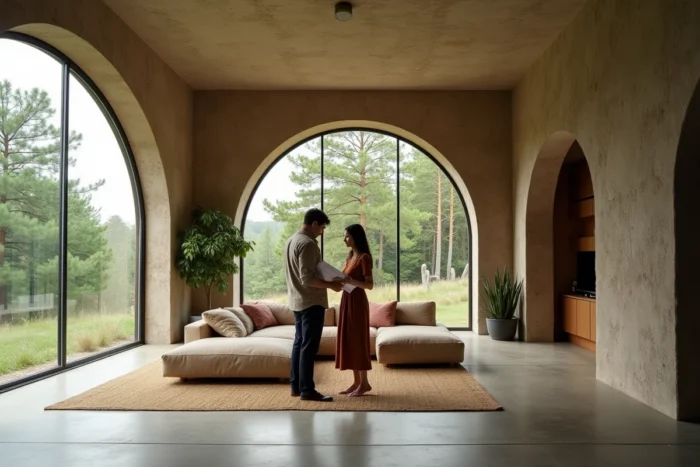
Unconventional Properties: Why This Segment Is Resisting the Crisis Better
Lofts, houseboats, renovated farms, or architect-designed homes are not following the same trajectory as the traditional market. Feedback from the field indicates that sales of unconventional properties held up in 2024 despite a context of crisis and political instability, with demand driven by buyers seeking a love-at-first-sight experience rather than a simple investment.
Several factors explain this resilience. The first relates to the structural rarity of the supply: an old textile workshop converted into a residence or a restored mill cannot be easily replicated. The second concerns the profile of buyers, who are often less dependent on bank credit and more motivated by a life project than by pure profitability calculations.
A Segment That Attracts Beyond the Luxury Market
The image of unconventional properties remains associated with the high-end market. The reality of the market is more nuanced. Tiny houses, co-housing projects, or barns to renovate are being sold at accessible prices in certain regions. The unconventional is not defined by price but by the deviation from construction and usage standards.
This diversity complicates estimation. Automated valuation tools struggle to process these properties, as reference databases (DVF, notarial files) do not always have relevant comparables. Support from a professional familiar with the local market remains the most reliable method for setting a coherent price.
Investment in Unconventional Properties: The Regulatory Framework to Watch
Buying an unconventional property to live in follows the classic path of real estate acquisition. Investing in placements related to so-called “diverse” properties (vineyards, parking lots, tourist residences, forests) adheres to different, recently tightened rules.
The Financial Markets Authority has amended its general regulations to more strictly govern these operations. Any promotional communication or solicitation regarding an investment in “diverse” unconventional properties now requires an AMF registration number, which must appear on the information document provided to investors. This tightening aims to protect individuals against the proliferation of poorly documented offers.
The practical consequences are clear:
- Before subscribing to an investment presented as “unconventional real estate,” check for the existence of the AMF registration number on the official document
- Distinguish between the direct purchase of a property (subject to the common law of real estate sales) and subscribing to a collective investment vehicle (subject to AMF control)
- Be wary of advertised returns without mention of fees, liquidity of the investment, and exit conditions

Estimation and Purchase of an Unconventional Property: Concrete Pitfalls
Estimation is the main point of friction. For a standard apartment, comparing with recent sales in the same building or neighborhood provides a credible range. For a livable lighthouse or a converted chapel, comparable references are often nonexistent in public databases.
AI-based estimation tools, which have proliferated since 2025, show significantly higher margins of error for this type of property. The available data do not allow for conclusions about their real reliability for niche segments. A physical expert report, conducted by a professional who has visited the property, remains the only defensible approach before a notary or banker.
Financing: More Complex Files to Assemble
Banks evaluate an unconventional property with caution. The absence of reliable comparables often leads to a discount in the estimation of the mortgage value, which reduces the amount that can be borrowed. Some institutions simply refuse to finance houseboats or light habitats.
Buyers targeting this segment should prepare a solid file in advance:
- Provide a recent independent appraisal conducted by an evaluator familiar with the property’s typology
- Anticipate a higher personal contribution than for a standard purchase, as banks rarely cover more than 70 to 80% of the estimated value
- Check the property’s urban planning compliance (building permits, change of use, potential classification as historical monuments)
The market for unconventional properties in 2026 is characterized by a paradox: demand remains strong, but the supply of quality is dwindling and the regulatory framework is tightening. Buyers who engage in this market benefit from treating each file as a particular case, relying on professionals capable of documenting the real value of the property and securing the financial setup.