
We buy a lot of meat on sale, prepare three saucy dishes on Sunday, and by Tuesday everything has turned into the back of the fridge. This scenario drives thousands of households each year to invest in a vacuum sealer. The problem is that the options range from a small bar sealer sold for around thirty euros to a semi-professional chamber machine, and the selection criteria differ depending on what you actually put in the bags.
Liquids and marinades: the criterion that most buyers discover too late
When packing a dry cutlet or a block of hard cheese, any external suction machine does the job. The problem starts with wet foods: marinated chicken, a stew, juicy fruits.
On an external suction machine, the pump sucks air through the opening of the bag. A liquid can rise into the suction channel and damage the pump. Sometimes, this issue is circumvented by pre-freezing liquid portions before vacuum sealing, but this is an additional constraint that ultimately discourages.
The chamber machine works differently: the entire bag is placed in a sealed chamber, and it is the air from the entire chamber that is evacuated. The liquid stays in place in the bag, without rising.
For those who regularly prepare saucy dishes, jars of sauce, or marinades, this is a considerable time saver. Feedback varies on the ease of cleaning the chamber, but the principle remains more reliable for anything containing juice.
Detailed comparisons and useful technical sheets can be found on machine-sous-vide.xyz, which helps to decide between these two families before pulling out the credit card.
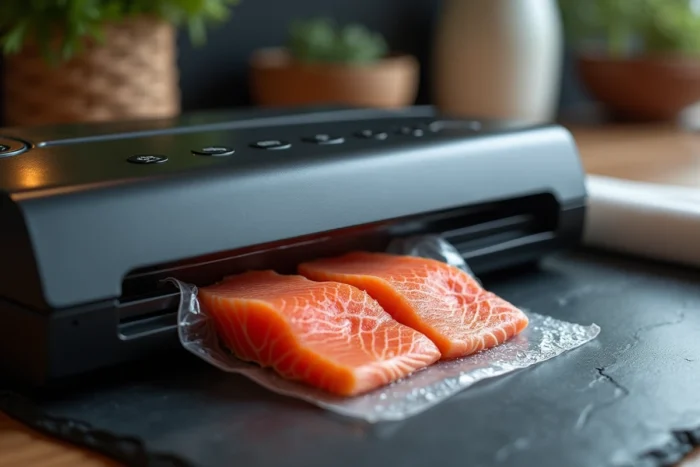
Suction power and sealing width: the two figures to check on the technical sheet
The power of the pump determines the quality of the vacuum obtained. A suction that is too weak leaves residual air in the bag, which reduces shelf life and promotes oxidation. On domestic models with external suction, significant discrepancies can be observed from one device to another. Looking at the maximum vacuum (expressed in kPa or mbar) provides a more reliable indication than the motor power in watts, which does not always reflect the actual suction efficiency.
Single seal or double seal
The sealing bar seals the bag after suction. A seal that is too short or too thin eventually gives way in the freezer, especially on thick bags. A double seal significantly reduces the risk of air re-entry during long-term storage. On entry-level models, the sealing bar often measures less than 30 cm, which limits the size of usable bags.
Before purchasing, it is advisable to check two points on the sheet:
- The maximum vacuum of the pump, which determines the quality of the vacuum and thus the actual shelf life of the food
- The length and type of seal (single or double), which determine the long-term airtightness and compatibility with wide bags
- The compatibility with embossed or smooth bags, as not all machines accept both types of bags
Embossed bags, smooth bags, rolls: the hidden cost of vacuum sealing
People often focus on the price of the machine, but the cost of consumables weighs more heavily on the budget in the long term. External suction machines require embossed bags (with micro-channels that allow air to circulate to the pump). These bags are more expensive than the smooth bags used by chamber machines.
Rolls allow for cutting custom-sized bags, which avoids plastic waste on small portions. This is a point to consider if you are packing varying quantities, from individual fish fillets to family roasts.
Frequency of use and profitability
For occasional use (once or twice a week), an external model with embossed rolls remains reasonable. Once you exceed several vacuum sealings per day, typically in batch cooking or meal prep for the week, the cost of embossed bags accumulates. A chamber machine with smooth bags becomes cost-effective with regular use.
External suction or chamber machine: comparison table to decide
| Criterion | External suction | Chamber machine |
|---|---|---|
| Dry foods | Very suitable | Suitable |
| Liquid or saucy foods | Limited (pre-freezing required) | Perfectly suitable |
| Footprint | Compact, easy to store | Bulky, requires dedicated workspace |
| Type of bags | Embossed bags required | Smooth bags (cheaper) |
| Purchase budget | Affordable | Significantly higher |
| Recommended use | Occasional to regular | Regular to intensive |
This table summarizes the main points, but the choice mainly depends on what you actually put in the bags. Someone who primarily freezes dry vegetables and portioned meat does not need a chamber machine. However, as soon as you work with cooked dishes or wet preparations, the chamber simplifies the entire process.
Hygiene and maintenance of the vacuum sealer: a often overlooked point
Food residues in the suction channel or on the sealing bar create a favorable environment for bacteria. Cleaning the sealing area after each session extends the lifespan of the device and ensures reliable seals.
On chamber machines, the stainless steel chamber is easily cleaned with a damp sponge. On external models, the suction channel can sometimes be difficult to access. Some manufacturers offer replacement seals and hoses, which avoids having to replace the entire device when the airtightness decreases after a few years of use.
Ultimately, choosing a vacuum sealer boils down to three concrete questions: what foods you are sealing (dry or wet), how often, and what budget you are willing to accept for the bags over time. Honestly answering these three points avoids most disappointing purchases.