
A hairless skull receives UV rays without any natural filter. The scalp skin, thin and constantly exposed, accumulates sun damage much faster than the rest of the body. Choosing a suitable cap to protect a bald head from the sun is based on measurable criteria, not on style. Material, textile protection rating, visor shape: each parameter alters the actual level of defense against ultraviolet rays.
UPF, material, and cut: comparison of solar protection criteria for caps
The choice of a sun protection cap for a balding head revolves around three axes. The table below summarizes the concrete differences between the most common options.
| Criterion | Standard Cotton | Technical Polyester | UPF 50 Certified Fabric |
|---|---|---|---|
| UV Filtration | Partial (varies with weaving) | Acceptable if the weave is tight | Blocks almost all UV rays |
| Breathability | Good, but retains moisture | Good sweat wicking | Variable depending on construction |
| Drying | Slow | Fast | Fast to moderate |
| UV Durability | Decreases with washing | Stable | Guaranteed by certification |
Cotton remains the most common reflex. Its filtration directly depends on the density of the weave: a fine, light cotton allows a significant amount of UV rays to pass through. Technical polyester generally filters better, but without certification, there is no guarantee of a precise threshold.
A fabric labeled UPF 50 blocks almost all ultraviolet rays, making it the most reliable reference for a bare skull. To effectively guide the choice of a cap for bald and balding heads, this criterion weighs more heavily than color or brand.

Classic cap or extended protection cap: how shape changes things
The shape of the cap determines the areas of the skull that are actually covered. A cap with a short visor protects the forehead and part of the top, but leaves the temples, ears, and neck completely exposed.
Models with a wide visor and neck flap cover more. On a bald head, the neck and the tops of the ears are frequent sunburn areas that a classic cap does not protect at all.
Flat visor or curved visor
The curved visor better fits the field of vision and casts shade on the sides of the face. The flat visor, inherited from streetwear, projects a narrower and less enveloping shadow. For sun protection of the scalp and face, the curved visor offers more uniform coverage.
Depth of the crown
A rarely discussed point: the depth of the crown alters the contact between the fabric and the skin. On a shaved head, a crown that is too tight presses the textile directly against the scalp. The UV filtration of a fabric decreases when it is stretched and compressed against the skin, as the space between the fibers opens up.
A slightly deeper crown, with a small volume of air between the fabric and the skull, maintains better filtration and limits heat buildup. This detail of cut often goes unnoticed, but it changes the sensation as much as the actual protection.
Thermal comfort and UV protection: two distinct functions
Caps and hats marketed as “cooling” use evaporation technologies or materials with a cooling effect. Their promise is about thermal comfort, not about solar protection for the skin.
A cooling hat can limit the feeling of heat on the skull without significantly blocking UV rays. For a bald head, confusing thermal comfort with UV protection is a common mistake. A fabric that feels cool does not filter ultraviolet rays better than a standard fabric of the same density.
- A UPF certified fabric protects the skin. A “cooling” fabric without UPF mention guarantees nothing regarding UV.
- Dark colors absorb more heat but generally filter UV rays better than a light fabric of the same thickness.
- Surface-applied anti-UV treatments (spray, impregnation) lose effectiveness after several washes, unlike fabrics whose protection is integrated into the fiber.
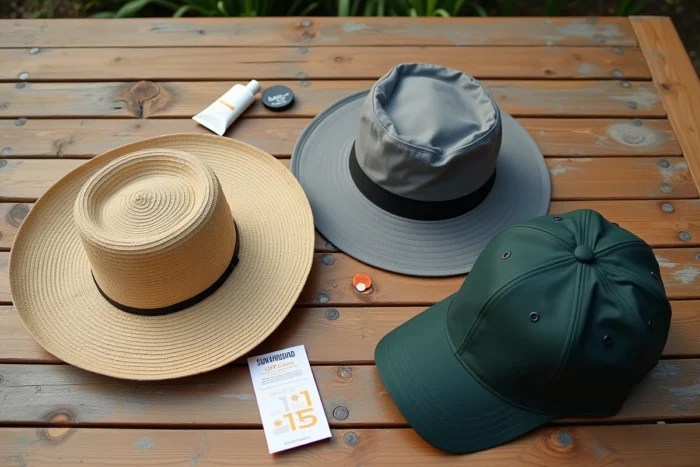
Multilayer protection for bald heads: the cap alone is not enough
No cap, even one certified UPF 50, covers the entire scalp at all times. Junction areas (ears, temples, neck) remain partially or totally exposed depending on movement.
Dermatologists recommend combining textile protection with a SPF 50+ sunscreen applied directly to the scalp. This combination covers the areas that the cap leaves uncovered and compensates for moments when the headgear is removed.
- Apply sunscreen all over the scalp before putting on the cap, including under the fabric.
- Reapply every two hours in case of sweating or swimming.
- Plan for regular dermatological monitoring of the scalp, an area often forgotten during skin checks.
The cap serves as the first barrier, the most visible and easiest to implement. Its limit is geometric: it only covers a fraction of the skull. Effective sun protection for a bald head combines UV-blocking textile and SPF 50+ cream, without relying on just one of the two.
The most reliable selection criterion remains the UPF rating of the fabric, combined with a cut that allows space between the crown and the scalp. Everything else (color, brand, trend) weighs less than these two measurable parameters.