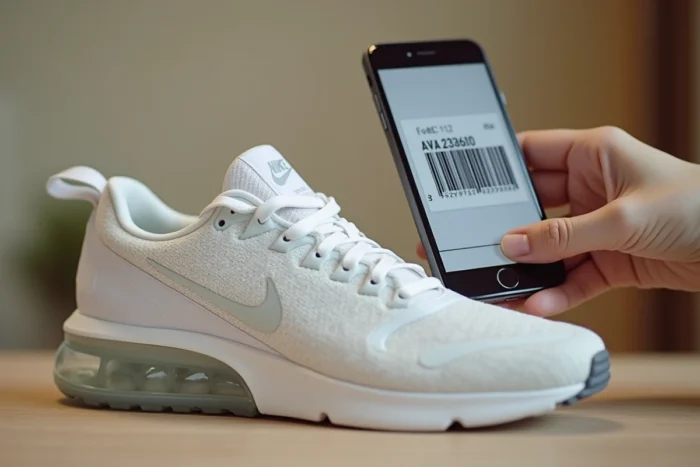
The Nike sneaker resale market handles considerable volumes, and counterfeits are becoming more sophisticated each year. Fake models are no longer easily identifiable by the naked eye as they once were: meticulous finishes, nearly identical boxes, labels reproduced with precision. The serial number remains one of the most reliable checkpoints for distinguishing an authentic pair from a copy, provided you know where to look and what to compare.
Nike QR code and SKU code: two complementary checks
Since the recent generations of models (performance and lifestyle), Nike has added a dynamic QR code associated with the product code (SKU) on the inner label. By scanning it with a smartphone, the user is redirected to the official model page on nike.com.
This QR code is not yet present on all older models. This is a useful clue: an ad claiming a recent release but showing an old-format label deserves suspicion. The SKU is found on the inner label of the shoe and on the box label. Both SKUs must match exactly, including color and size.
To reliably check the Nike serial number, you need to cross-reference the code printed on the inner label with the online product sheet. A search for the SKU on nike.com or the Nike app should display the exact model in the correct colorway. If the code leads to nothing or to another model, the pair is suspect.
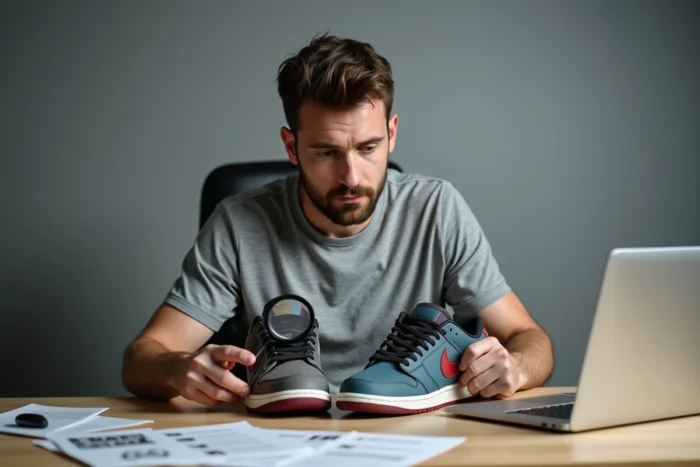
Nike inner label: details that counterfeiters still miss
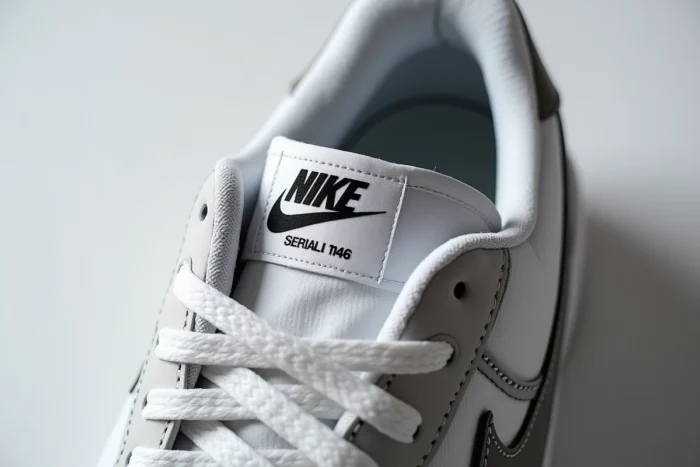
The size label, sewn inside the shoe (usually under the tongue or on the side of the heel), contains several usable pieces of information. Beyond the SKU, it includes the country of manufacture, size in multiple systems (US, UK, EUR, cm), and a barcode.
On an authentic pair, the characters are sharp, straight, and perfectly aligned. Counterfeits often show visible anomalies under magnification or even to the naked eye:
- Font slightly different from that used by Nike, with thicker or thinner letters than the norm
- Approximate alignment of text lines, with a shift between size columns
- Irregular spacing between the digits of the barcode or SKU
- Absence of regulatory symbols (trademark, standards) normally present on labels of recent production
Comparing the label with reference photos of the same model remains the most accessible method. Collector communities catalog variations in tags, style numbers, and serial numbers by year and factory, with supporting photos. These databases help identify inconsistencies that isolated inspection might not reveal.
Verification via the Nike app and SNKRS: what works and what doesn’t
The Nike app and the SNKRS app now include verification functions for certain limited releases. By scanning the product code or the QR code on the box, the user accesses the drop sheet and can verify the consistency of the colorway, size, and release date.
This feature, gradually introduced from the 2024-2025 collection, is limited to certain models. It does not cover the entire Nike catalog, and models purchased on the secondary market (resale between individuals, third-party platforms) do not always benefit from this digital tracking.
General content on counterfeits remains focused on visual inspection (stitching, swoosh, sole). Nike’s digital tool adds an extra layer of verification, but it does not replace physical examination. A sophisticated counterfeiter can reproduce a QR code that leads to a page mimicking the official site. Checking that the destination URL is indeed nike.com (and not a variant) is part of the verification process.
Known limitations of digital verification
Field reports vary on the reliability of QR scans for pairs made in certain Asian factories where label formats differ. An authentic pair from a specific production line may display a QR code that leads to a temporary error page, without it indicating a counterfeit.
Digital verification is therefore only a supplement. It reduces risk but does not eliminate it.
Cross-referencing physical and digital clues: a three-step method
Rather than a linear checklist, verification gains reliability when it cross-references multiple sources of information. Here’s a sequence that covers the most discriminating angles:
- Scan the QR code (if present) and check that the URL points to nike.com with the correct model and colorway
- Compare the SKU on the inner label with that on the box, then search for this SKU on the official Nike website
- Examine the inner label by comparing it to reference photos of the same model from community databases
A single suspicious clue is not enough to conclude, but two converging anomalies (SKU absent from the Nike database and non-compliant label font, for example) constitute a strong signal.
The quality of counterfeits is improving, and verification methods must keep pace. The tools integrated into the Nike apps represent a step forward, but their partial coverage of the catalog limits their scope. Cross-referencing digital verification and physical inspection remains the strongest combination for a purchase on the secondary market.