
Choosing a thermal brush cutter to maintain your garden requires considering several criteria that go beyond just reading the technical specifications. Since the law of April 15, 2024, the legal framework surrounding the noise from motorized gardening tools has tightened, and the market itself is evolving under the pressure of battery alternatives. These two parameters change the selection criteria well beyond just the engine displacement.
Noise and regulation: what the law of April 15, 2024 changes for choosing a thermal brush cutter
The noise of a thermal brush cutter is not just a matter of comfort. Since the inclusion of abnormal neighborhood disturbance in the Civil Code by the law of April 15, 2024, the use of a thermal brush cutter in residential areas is assessed based on the duration, repetition, and intensity of the noise, rather than solely according to municipal time slots.
Fines are possible. In cases of serious abuse, the seizure or confiscation of the equipment may be ordered. For an individual using their machine several times a month in a housing development, choosing a quieter model is no longer a comfort option; it is a legal precaution.
Manufacturer data, expressed in decibels, varies according to the testing protocol and does not always reflect the perceived noise level in real conditions. Listening to a machine running at full speed in a store or at a neighbor’s place remains the most reliable way to get an idea. Before purchasing, checking the municipal orders of your commune and estimating the expected frequency of use allows for a better assessment of the actual risk.
Resources like top-debroussailleuse-thermique.com compile detailed comparisons that can help refine this type of choice by crossing several technical criteria.
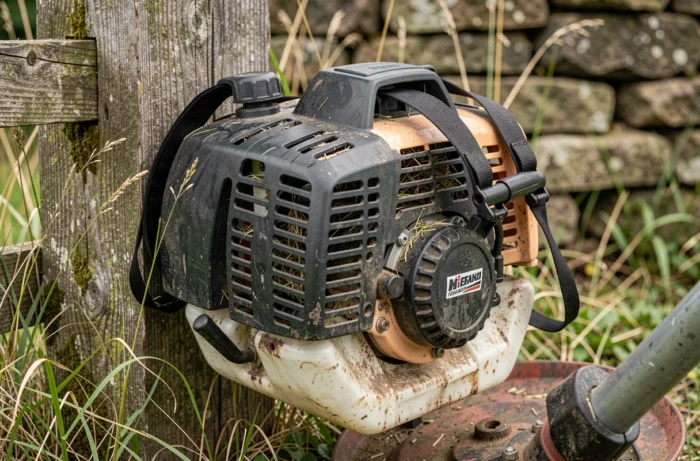
Engine displacement and type of vegetation: the true sizing criterion
Displacement remains the central technical parameter of a thermal brush cutter. It determines the machine’s ability to tackle more or less dense vegetation and also affects weight, consumption, and noise level.
A common pitfall is over-sizing. A primary residence garden with borders, flower beds, and a few grassy slopes does not require the same displacement as an overgrown wasteland filled with brambles. Buying a machine that is too powerful means accepting a higher weight, increased fatigue, and louder noise, without any real gain in results.
Adapting displacement to the terrain
- For trimming and low grasses on flat terrain, low-displacement models are sufficient. They are lighter and more maneuverable, suitable for regular short-duration use.
- For tall grasses, medium brush, or sloped terrain, an intermediate displacement offers better torque without excessively weighing down the machine.
- For intensive clearing with brambles, tree shoots, or woody vegetation, high displacements become necessary, but they are intended for semi-professional use and require a suitable harness.
The right sizing depends on the vegetation, not the surface area of the terrain. A small garden overrun with brambles requires more power than a large regularly maintained area.
Two-stroke or four-stroke engine: a technical choice with practical consequences
Most thermal brush cutters are equipped with two-stroke engines. These engines are lighter for the same displacement, which explains their predominance in portable machines. However, they consume a mixture of oil and gasoline, the preparation of which requires a minimum level of diligence.
Four-stroke engines, less common in this segment, generally produce fewer vibrations and fumes. Their maintenance is similar to that of a conventional lawn mower with a separate oil sump. The four-stroke engine is heavier, which can become a limiting factor during prolonged sessions or on sloped terrain.
The available data do not allow for a definitive conclusion regarding the lifespan advantage of one over the other. Longevity depends more on the quality of maintenance (air filter, spark plug, lubrication of the bevel gear) than on the type of engine cycle.
Cutting system: line, blade, or disc according to actual use
The cutting system is the second criterion to consider after displacement. It determines what the machine can actually cut and under what safety conditions.
The line head is suitable for soft grasses and finishing touches. It tolerates accidental contact with borders, fences, or tree trunks. Its main drawback is the rapid wear of the line on dense vegetation, which necessitates frequent reloading.
Metal blades and discs tackle brambles, woody brush, and shoots. Their effectiveness on thick vegetation is incomparable to that of the line. However, the risk of projection is higher, and use on rocky terrain requires increased vigilance.
Many models accept both types of cutting, which offers appreciable versatility. Checking the compatibility of accessories before purchase avoids unpleasant surprises: not all bevel gears can support heavy discs.
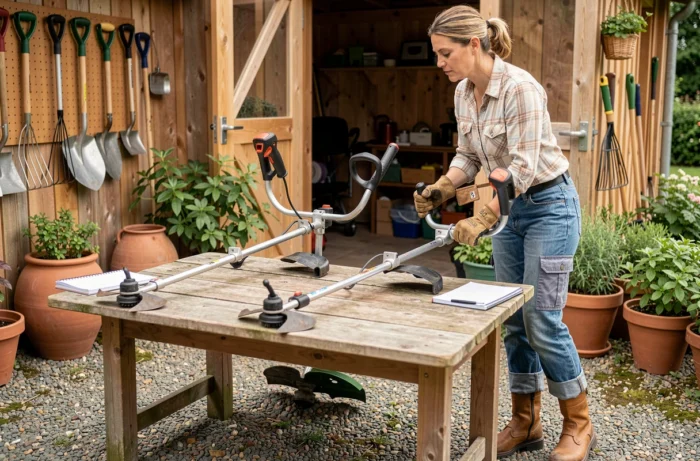
Thermal brush cutter or battery: where is the boundary in 2025
Recent market feedback shows a growing preference among individuals for battery brush cutters, primarily to reduce noise and emissions. This trend does not render the thermal brush cutter obsolete, but it redefines the relevant usage perimeter.
For short sessions in accessible terrain, the battery now covers the majority of needs for a residential garden. The thermal brush cutter retains a clear advantage on large areas and dense vegetation, where unlimited autonomy (a full tank can be replenished in seconds) and superior engine torque make a difference.
For an individual who is hesitant, the question to ask is not “thermal or battery” in absolute terms, but rather: what is the toughest vegetation I will need to cut, and how long does a typical session last? If the answer is “tall grasses for twenty minutes,” the battery may suffice. If the answer involves brambles on sloped terrain for more than an hour, the thermal option remains the most reliable choice.
The regulatory framework on noise, the exact nature of the vegetation, and the expected duration of use form the three parameters to consider before consulting product sheets.