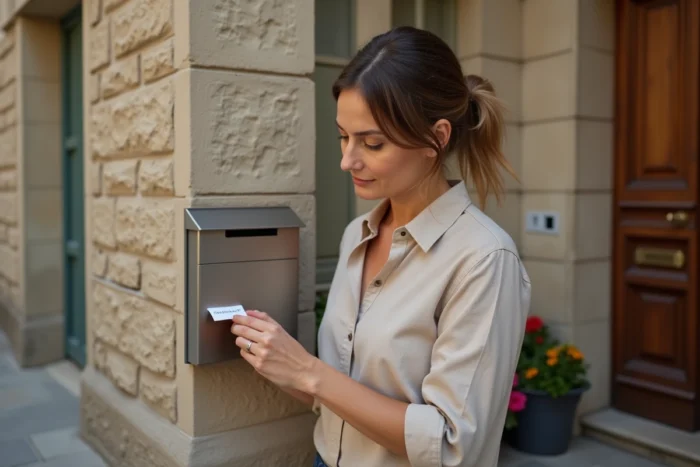
A couple moves in together, a parent temporarily hosted, a roommate added to the lease: the question of the label on the mailbox always arises when the mail carrier cannot find the right name. Displaying multiple names on the same mailbox is perfectly legal, provided that a few readability and co-ownership rules are respected, which most residents ignore.
Name board and nameplate: the standards that govern display
It is often thought that the label stuck on the mailbox is sufficient. In a collective building with more than six mailboxes, a name board is mandatory. This board must list the names of the occupants in alphabetical order, associated with the mailbox number and the apartment number.
The individual nameplate must conform to a standardized format of about 100 by 22 mm. It is a limited space. When trying to include two or three names, the font size quickly decreases and readability drops. The mail carrier delivers based on what they can read: if a name is truncated or illegible, the mail is returned.
For buildings constructed after 1979, the decree of June 29, 1979, mandates the presence of a standardized nameplate on each mailbox. No text limits the number of names on this nameplate, but each name must remain individually legible. In practice, beyond three names, one reaches the physical limits of the standard label.
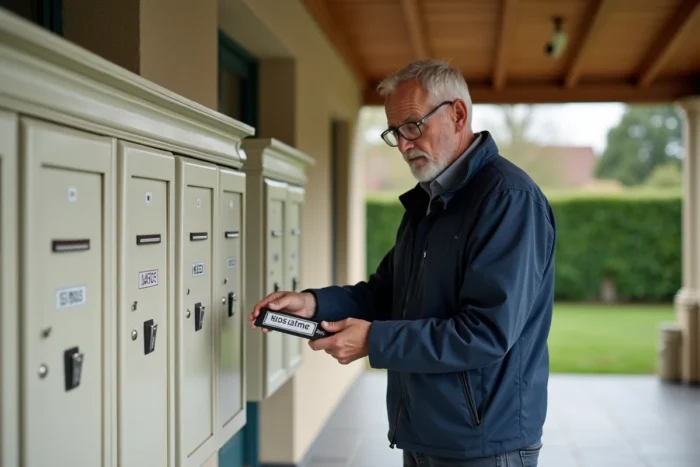
Co-ownership and property manager: who decides to add a name
In a single-family home, the question does not arise: one is free to write whatever they want on their own mailbox. In co-ownership, the situation is different. The conditions for displaying multiple names on the same mailbox should be verified before any steps are taken with the property manager.
The property manager manages the common areas, and collective mailboxes are part of that. Adding a name generally requires notifying the property manager, especially if the building has a centralized name board. Some property managers impose a uniform label format for all mailboxes (color, typography, dimensions). Modifying the label without adhering to this format can lead to the outright removal of the plaque.
Responses vary on this point: some property managers accept a simple email notification, while others require proof of residence from the new occupant. When the added name corresponds to a temporarily hosted person or a roommate not listed on the lease, the co-ownership may request a hosting certificate.
The case of tenants
The name on the mailbox must correspond to that on the lease. For a tenant, adding the name of a spouse, an adult child, or a roommate amounts to notifying the landlord and the property manager that another person resides in the apartment. This is not trivial: the lease may contain clauses regarding the occupancy of the apartment.
If the roommate is listed on the lease or an amendment, adding their name to the mailbox is a simple act of postal common sense. If the person is hosted without being on the lease, it is better to formalize the situation (hosting certificate, declaration to the landlord) before altering the label.
How to write a readable label with multiple names
The issue is not decorative; it is functional. The mail carrier passes by each mailbox in a few seconds. Here are the points to check to ensure that the mail reaches each occupant:
- Write the last name in uppercase, followed by the initial of the first name. The full first name is optional and takes up space
- Separate each name with a line break or a slash if space is limited (DUPONT M. / MARTIN L.)
- Respect the minimum character size so that each name remains legible at arm’s length, which is about half the height of the nameplate for two lines
- Use a printed label rather than a marker that fades with humidity. Engraved plaques withstand the test of time better
On a standard label of 10 by 2.5 cm, two names fit comfortably, three still work. Beyond that, a larger label should be considered, which the standardized nameplate does not always allow.
AFNOR standard and mailbox dimensions
Collective mailboxes must meet standards regarding dimensions, installation height, and access for the mail carrier. The AFNOR standard governs these technical specifications. The nameplate is an integral part of the standardized mailbox: one cannot stick a label outside the template that would overflow onto the mail slot or the lock.
Privacy and GDPR: can one refuse to display their name
No legal obligation compels a resident to display their name on their mailbox. There are no fines or penalties for an anonymous mailbox. The trade-off is direct: without a displayed name, the postal service considers the recipient as unknown at the address. Registered letters, packages, and regular mail are returned to the sender.
People concerned about their privacy (victims of harassment, dangerous situations) can ask the property manager to limit the display to the strict minimum. The GDPR protects personal data, and a name on a mailbox constitutes identifying data. In these particular cases, an arrangement with the property manager and the local post office sometimes allows the use of a code or mailbox number instead of the name.
Adding a name to a mailbox remains a simple gesture, but one that affects mail delivery for all occupants. The label must remain legible, conform to the nameplate format, and be consistent with the rental or co-ownership situation. A quick exchange with the property manager or landlord before making any changes avoids unpleasant postal surprises.