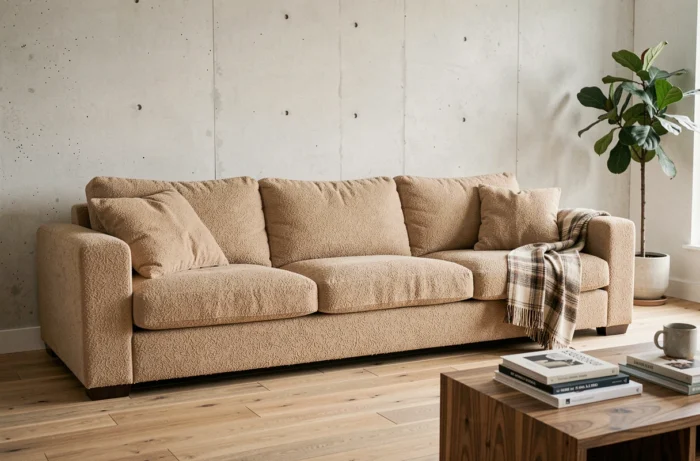
Choosing a sofa for your living room involves balancing criteria that are rarely aligned: seating comfort, durability of the upholstery, size, and decorative coherence. Instead of listing dozens of sofa brands, this article compares the technical parameters that truly distinguish the ranges available in France, from fabric to leather, from modular to convertible.
Comparison of sofa types by usage and upholstery
The French market offers sofas in very varied configurations. To clarify, a summary table allows us to cross-reference the shape of the sofa with the type of upholstery and the main usage.
| Type | Common Upholstery | Main Usage | Point of Caution |
|---|---|---|---|
| 2-3 Seater Straight Sofa | Fabric, velvet | Small living room, compact living space | Check seat depth |
| Corner Sofa | Fabric, leather | Large living room, family | Total dimensions and door access |
| Convertible Sofa | Fabric, polyester | Studio, guest room | Mechanism and mattress thickness |
| Modular Sofa | Velvet, removable fabric | Evolving decor, shared living | Connection between modules |
| Cloud / Rounded Sofa | Loop fabric, velvet | Design living room, cocooning atmosphere | Care for loop fabric |
Rounded sofas, sometimes referred to as “bubble” or “cloud,” represent a strong trend in interior decoration. Their rounded aesthetic is prominent in living rooms that seek a pronounced cocooning effect.
In contrast, the corner sofa remains the dominant choice for families. Its footprint is significant, and measuring the room dimensions before purchase avoids many disappointments during delivery.
To delve deeper into this topic, a selection of sofa brands details the French and European brands that cover these different types.
Velvet, leather, loop fabric: which upholstery for which living room
The upholstery influences both the style and longevity of the sofa. Three main families dominate living room furniture in France.
Fabric and Velvet
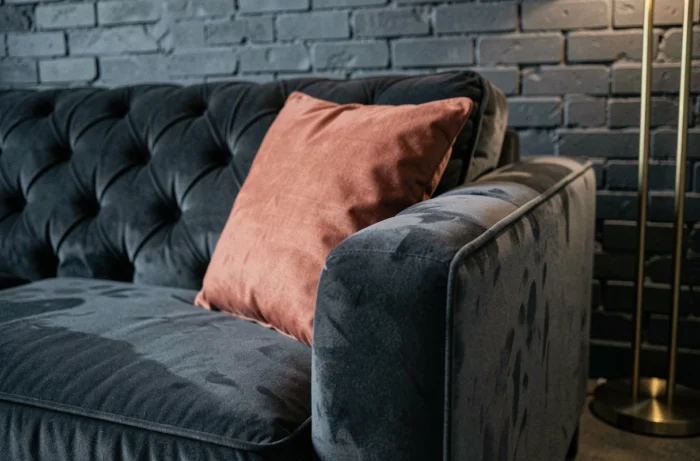
Fabric remains the most common upholstery. It offers the widest choice of colors and adapts to all styles of decoration. Velvet provides a visual depth that standard fabric does not replicate, but it requires more regular maintenance, particularly against friction marks.
Loop fabric, associated with cloud sofas, is appealing due to its irregular texture. Its resistance to wear varies greatly depending on the density of the weave.
Full Grain Leather and Reconstituted Leather
Full grain leather ages better than any other upholstery, provided it is regularly nourished. It is suitable for interiors where the sofa is used daily. In contrast, reconstituted leather (or leather split covered with polyurethane) offers a similar new look but cracks more quickly.
- Full grain leather: natural patina, high resistance, higher budget at purchase
- Reconstituted leather: accessible price, aesthetics close to leather, limited lifespan of a few years
- Removable fabric: maximum practicality for families with children or pets, machine washable depending on the models
- Velvet: high-end appearance, sensitive to scratches and humidity
Convertible Sofa: the mechanism matters more than the brand
Competitors focus on brands and styles. The rarely addressed angle concerns the internal mechanism of the convertible, which determines the actual comfort for sleeping.
A “rapido” type mechanism offers a decent daily sleeping surface, with a real integrated mattress whose thickness exceeds that of models with visible slats. The “clic-clac” or “BZ” systems, which are less expensive, are suitable for occasional use but can strain the back more quickly over time.
Regulations are also evolving in this segment. A regulatory text published in 2026 anticipates stricter fire reaction requirements for convertible sofas intended for public establishments, applicable to work authorization requests submitted from June 1, 2027. Specifically, the structures and padding materials must meet a documented fire classification (M3 classification or Euroclasses).
For domestic use, this standard does not apply directly. However, it encourages some brands to anticipate by improving the technical documentation of their products, which indirectly benefits private buyers concerned about safety.
Colors and materials: combinations that work in living room decoration
The 2026 trends in living room furniture favor natural materials and muted colors. Light wood, linen, and rattan accompany sofas in neutral shades: beige, stone gray, terracotta.
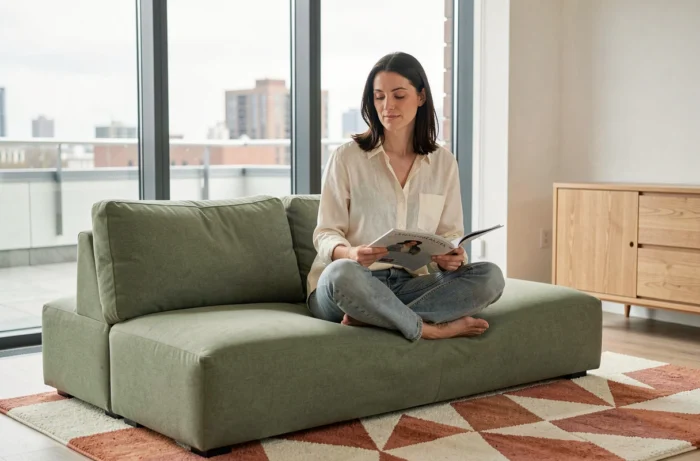
A sage green or terracotta velvet sofa anchors the style of a living room without necessitating a complete change of the rest of the furniture. These colors match both white walls and deeper shades.
The choice of fabric also influences the perception of space. A light upholstery visually enlarges a compact room, while a dark velvet structures a large living room by creating a focal point.
A common mistake is to choose the color of the sofa last, after the walls and floor. The sofa occupies too large a visual area in a living room to be relegated to an accessory role. Starting from the sofa to build the color palette of the living room yields a more coherent result.
The selection of a sofa depends less on the prestige of a brand than on the compatibility between the internal mechanism, the upholstery, and the actual constraints of the living room. The new regulatory requirements on fire reaction, even if they primarily target professional spaces, push the market towards greater technical transparency, a criterion to watch when purchasing upholstered furniture.