
Flourishing parenthood refers to an educational stance where the well-being of the child and that of the parent are treated as interdependent. Far from an abstract ideal, this approach relies on concrete mechanisms: emotional regulation, organization of family daily life, and attention to the mental health of each household member.
Parents’ mental health: an underestimated lever of flourishing parenthood
The enhanced parenthood pathway 2025-2027 now places parents’ mental health on par with somatic follow-up in perinatal care. This paradigm shift acknowledges a long-ignored fact: an exhausted or psychologically distressed parent cannot provide a serene environment for their child, regardless of their good intentions.
The early postnatal check-up, made mandatory in France since 2022 and conducted between the fourth and eighth week after birth, serves as the main tool for identifying psychological vulnerabilities. A second check-up is possible between the tenth and fourteenth week if risk factors are identified.
This systematization of parental psychological follow-up is part of the “1000 first days” initiative, renewed and enriched for the period 2025-2027. The associated website and app offer an eight-step journey, with resources tailored to each phase, from pregnancy to the child’s early years. Additional resources on daily life with a baby are available at https://www.lesbabillagesdebabinette.com/, which addresses family life from a practical angle.
Solo parenting deserves particular attention in this context. Single-parent families often face mental load and isolation, two factors that weaken mental health. Identifying one’s own warning signs (persistent sleep disturbances, chronic irritability, loss of pleasure in interactions with the child) remains the first step towards appropriate support.
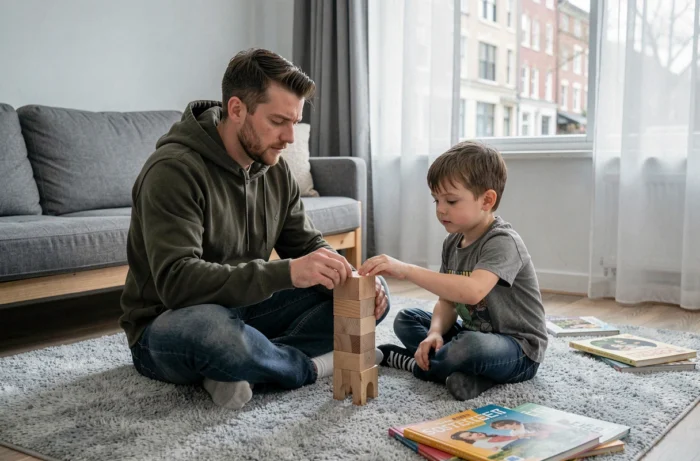
Emotional regulation in the family: a shared learning
Emotional regulation is not taught through verbal instructions. A child learns to manage their emotions by observing how their parents manage theirs. This modeling mechanism works from the first months of life and strengthens until adolescence.
Specifically, three parental skills directly influence the child’s ability to regulate their emotions:
- Naming their own emotional states aloud (“right now, I am frustrated because…”) allows the child to associate precise vocabulary with diffuse bodily sensations
- Accepting the child’s emotion before attempting to resolve it, which validates their feelings and decreases the intensity of the reaction
- Establishing a shared calming ritual (breathing, a moment of silence, physical contact) that both parent and child use together
A common pitfall is to confuse regulation with suppression. Asking a child to “calm down” without providing a strategy amounts to demanding a result without giving a tool. Positive parenting hinges on this distinction: welcoming the emotion is not yielding to the behavior.
Evening, a pivotal moment for family emotions
Accumulated fatigue makes the end of the day conducive to tensions. The evening ritual represents a concrete lever to diffuse this spiral. Rather than a mechanical sequence (dinner, bath, bedtime), transforming this moment into a space for exchange alters the family dynamic.
A simple format: each family member shares a pleasant moment from their day and a difficulty encountered. This ritual fosters both gratitude and the ability to verbalize problems, two skills useful well beyond childhood.
Organization of family daily life: structuring without rigidifying
The parental mental load arises less from the volume of tasks than from their permanent and invisible nature. Planning meals, anticipating medical appointments, managing school logistics: this cognitive load disproportionately weighs on one parent in the majority of households.
The solution does not lie in a military organization of daily life. It involves the explicit redistribution of responsibilities. A concrete tool: the family task distribution chart, where each recurring task is assigned by name, including the planning load itself.

Child’s sleep and parental rhythm
Sleep is a determining factor in the family climate. A child who sleeps poorly generates a parent who sleeps poorly, and the fatigue spiral degrades all daily interactions.
Some structuring guidelines work better than rigid rules:
- Maintaining regular bedtimes, including on weekends, with a margin of about thirty minutes
- Reducing screen exposure in the hour leading up to bedtime, for both parent and child
- Creating a predictable sequence (three or four steps always in the same order) that signals to the brain the transition to rest
The regularity of the rhythm matters more than the exact bedtime. A child who falls asleep at the same time each night, even if late, generally sleeps better than a child whose bedtime varies from day to day.
Positive parenting and educational limits: moving beyond false opposition
Gentle parenting is sometimes perceived as incompatible with setting limits. This interpretation is based on a misunderstanding. Establishing a clear framework is an integral part of flourishing parenthood: the child needs predictable limits to feel safe.
The difference lies in how these limits are set. An explained rule (with age-appropriate words) garners more adherence than a rule imposed without context. The parent does not need to be permissive to be kind, nor authoritarian to be respected.
The guide to the “1000 first days” reminds us that consistency in applying rules reassures the child, provided these rules remain appropriate for their developmental stage. A framework that evolves with the child is not a fragile framework; it is a living framework.
Parental flourishing is not decreed and cannot be measured by the standard of a perfect day. It is built through attention to signs of fatigue, the quality of family rituals, and the acceptance that some days will be more challenging. The enhanced parenthood pathway and postnatal follow-up tools now offer a concrete safety net for parents in need, provided they know of their existence and dare to utilize them.