
A child who refuses to eat at the table, a parent checking work emails during dinner, a weekend where everyone stays in their own room: these micro-situations, repeated over time, create a distance that no one really chose. Building a fulfilling family life on a daily basis doesn’t rely on grand abstract principles, but on concrete, often modest adjustments that can change the atmosphere of the home in just a few weeks.
Financial stress: the primary obstacle to family balance
We often talk about communication or shared time, but rarely about the weight that economic constraints place on the home environment. This topic deserves to open the article because it conditions everything else.
In 2024, approximately 2.9 million children live below the poverty line in France, and the poverty rate for single-parent families reaches 34%. Even above this threshold, ongoing budgetary trade-offs (school meals, extracurricular activities, vacations) generate a silent tension between parents, and then between parents and children.
There are some concrete levers to reduce this stress without waiting for an increase in income. Meeting once a month, as a couple or as a family if the children are old enough, to discuss upcoming expenses can transform diffuse anxiety into a shared action plan. You can find information on Myblog that details approaches suitable for different family configurations.
Visibly distributing the financial burden, even symbolically (a teenager financing part of their phone plan with a summer job, for example), gives each member the feeling of contributing rather than just enduring.
Daily family rituals: three formats that last
Family rituals come up in all parenting advice, but most families abandon them after a few weeks because they are too ambitious. The key is to choose a format that is short enough to withstand busy weeks.
The dinner roundtable in three minutes
Each family member shares a positive moment from their day. No debriefing, no moral lessons, just one sentence per person. This format works even with children as young as four or five, and it refocuses the meal on something other than logistics.
The fixed screen-free time slot
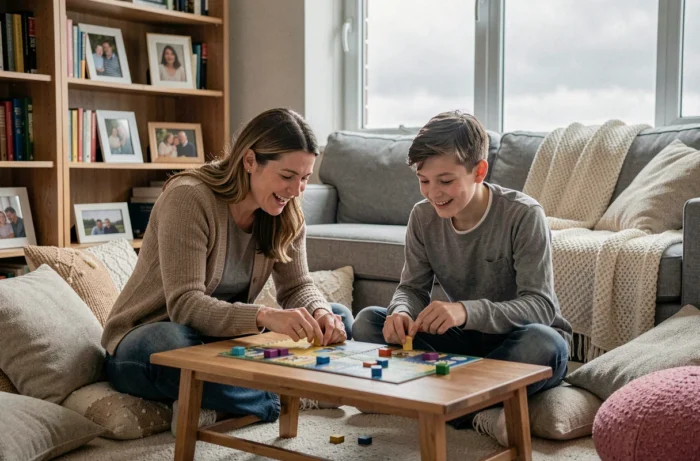
We’re not talking about eliminating screens from the home, but about identifying a single weekly time slot where phones and tablets stay in a drawer. Sunday morning for a leisurely breakfast, Wednesday afternoon for a board game, Friday evening for cooking together. A unique and regular time slot is better than daily prohibitions that no one respects.
Individual parent-child time
When there are several children, each ends up only experiencing collective moments. Setting aside twenty minutes a week with just one child (a walk, a shopping trip together, a workshop) changes the dynamic. Feedback on this point varies depending on the children’s ages, but the principle remains the same: exclusive attention, even briefly, strengthens the bond more than a whole day in a group.
Mental load and task distribution within the couple
The mental load is not just a topic of debate between partners. It directly impacts the children, who pick up on fatigue, irritation, and unspoken issues long before we explain anything to them.
A method that works in practice is to list, on paper or on a visible board, all the invisible household tasks: making medical appointments, checking food stocks, monitoring homework, managing sports registrations. Making the invisible visible often triggers a rebalancing without conflict.
Points to clarify during this review:
- Daily tasks (meals, laundry, tidying up) and their current distribution, honestly noted by each parent
- Weekly tasks (shopping, deep cleaning, school follow-up) with an assigned and non-negotiable time slot
- Occasional but heavy tasks (administrative work, vacation planning, managing health emergencies) that almost always fall on the same person
We are not looking for a 50/50 arithmetic split, but a distribution perceived as fair by both parents. It is this perception of fairness that protects the couple’s balance and, by extension, the family climate.

Parental separation: preserving children’s daily life
An analysis note from France Stratégie/Ined published in January 2024, covering 753,000 children, shows that parental separation leads to a 19% decrease in living standards on average in the year of the breakup. This figure reminds us that family well-being does not stop at the door of a functioning couple.
For separated parents, maintaining stable reference points for the children involves simple but structuring gestures:
- Keeping the same bedtimes and food rules in both households, even if the living situations differ
- Never using the child as a messenger between the two parents, even for practical matters
- Maintaining extracurricular activities and rituals (birthdays at friends’ houses, Wednesday sports) regardless of the custody schedule
These adjustments do not resolve the complexity of a separation, but they provide children with a foundation of predictability that limits stress.
Parents’ mental health: the often-overlooked link
We invest a lot of energy in the well-being of children, sometimes to the point of forgetting that exhausted parents cannot build a serene home. The issue goes beyond the simple “break” or “me time” that magazines recommend.
In practical terms, this means accepting to delegate (even imperfectly), setting clear boundaries on work hours when remote work blurs the lines, and consulting a professional without waiting for a breaking point. Paternity leave, which has been increasingly utilized since its extension, also contributes to this balance by involving fathers from the very first weeks.
A home where each adult preserves a space for recovery, even if limited, absorbs daily tensions better. A fulfilling family life does not rely on the permanent sacrifice of one parent, but on a system where everyone, including children, contributes and recharges at their own pace.